
Looking Beyond Standard Procedures to Understand Laboratory-Generated Evidence
Routine laboratory procedures are generally regarded as standardized technical activities performed according to established protocols. Laboratories are expected to follow standard operating procedures, maintain accreditation, participate in quality assurance programs, and consistently generate reliable laboratory results. These elements are fundamental and constitute the basis of laboratory quality.
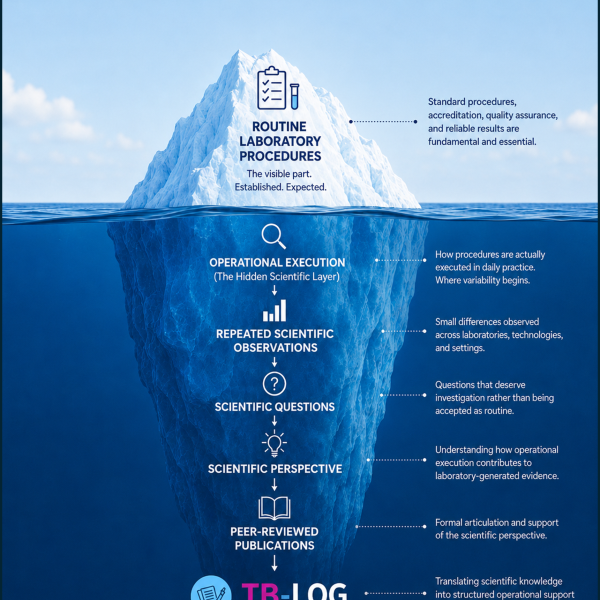
However, throughout my career, I gradually came to realize that routine laboratory procedures were far more than the routine activities they appeared to be. More than twenty years ago, while working at the laboratory bench during my early tuberculosis research, I began noticing that apparently identical procedures sometimes produced different laboratory results. Small differences in specimen handling, suspension preparation, vortexing, pipetting, and other routine technical activities occasionally appeared to influence what was ultimately observed. At first, because these observations appeared to be isolated technical issues, my objective was simply to understand why results sometimes differed and how laboratory procedures could be better standardized to improve consistency.
As my career progressed through laboratory research, laboratory management, staff training, and scientific operational oversight across different countries, those observations became increasingly consistent. Rather than isolated events, they appeared repeatedly across different laboratories, technologies, and operational settings. I gradually realized that routine laboratory procedures involved much more than the completion of routine tasks. Behind apparently standardized procedures, I repeatedly observed subtle differences in operational execution that raised scientific questions deserving careful investigation rather than being accepted simply as part of routine laboratory practice. Over the years, I also realized that standardization extends far beyond laboratory methods. It includes how routine laboratory activities are organized, communicated, supervised, documented, and consistently executed.
This realization gradually changed the way I understood laboratory work. I came to recognize that the routine procedure itself was never the scientific question. The real scientific question was understanding how the execution of those standardized laboratory procedures contributed to the laboratory result and, ultimately, to the laboratory-generated evidence used for patient care, diagnostic development, and clinical research.
Over time, these individual technical observations evolved into a broader scientific perspective. Rather than asking whether laboratories had standard operating procedures, I became increasingly interested in understanding how those routine procedures were being executed in daily practice, and whether that operational execution contributed to the evidence generated by the laboratory.
Once this scientific perspective had matured, I realized that scientific knowledge becomes truly valuable only when it can be translated into practice. That realization naturally led to the development of TB-LOG.
TB-LOG was not created simply to provide another laboratory consulting service. It was established to translate this scientific perspective into structured scientific operational support that complements existing laboratory quality systems, clinical trial oversight, and diagnostic implementation. The recently developed framework, TB-LOG Supporting Clinical Trial Managers, represents the first practical translation of this perspective by describing how specialized scientific operational support may complement Clinical Trial Managers responsible for the laboratory component of tuberculosis clinical trials.
Looking back, I realize that the most important lesson was not simply that routine laboratory procedures can influence laboratory results. It was that routine laboratory procedures should never be viewed as merely routine. Routine procedures may be standardized, but their execution is not always identical. It is within those differences in execution that scientific questions emerge, operational variability becomes scientifically relevant, and laboratory-generated evidence begins to take shape.
Ultimately, within everyday laboratory procedures lie scientific questions that deserve to be recognized, investigated, and understood. Answering those questions not only strengthens laboratory practice but also contributes to more reliable laboratory-generated evidence, more robust clinical research, and better-informed decisions for patient care and public health.
Related publications
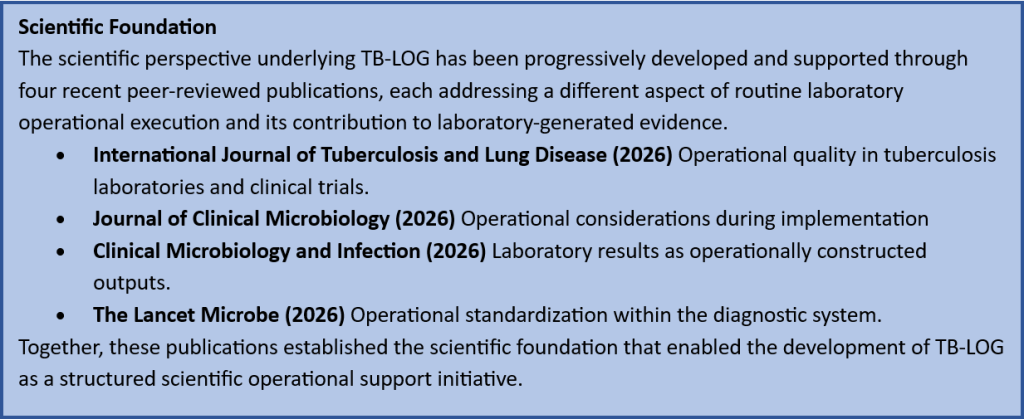
Readers interested in exploring the scientific foundation of this perspective can find the four supporting peer-reviewed publications in the Publications section of the TB-LOG website.