
Over the past week, I had the opportunity to learn from researchers, developers, implementers, and innovators working across the TB diagnostic landscape.
The technologies presented were remarkably diverse. Molecular platforms, sequencing approaches, AI-supported tools, blood-based biomarkers, tongue swabs, breath analysis, and decentralized testing strategies all seek to address different challenges in TB diagnosis.
Yet despite these differences, a common theme repeatedly emerged.
Many innovations are designed to simplify diagnostic pathways, decentralize testing, reduce infrastructure requirements, and bring diagnostic services closer to patients. These advances are essential to closing the TB diagnostic gap.
I would like to acknowledge the remarkable effort being made by researchers, developers, implementers, funding agencies, and global health organizations to accelerate the development and adoption of new diagnostic technologies. Their work is bringing better diagnostic tools closer to the patients who need them most.
Technology continues to evolve rapidly. As these innovations move from development to evaluation and implementation, understanding how they perform under real-world conditions becomes increasingly important. Sustained performance depends on the technology itself and also on the conditions under which it is implemented and routinely used.
For me, one of the most important lessons from this course is that laboratory operational execution deserves greater visibility and scientific attention.
This perspective, focused on operational execution, is not intended to replace existing quality systems, accreditation standards, monitoring activities, or laboratory quality requirements. Rather, it seeks to complement them by improving the visibility and scientific understanding of how laboratory activities are performed in practice and how operational variability may influence diagnostic performance.
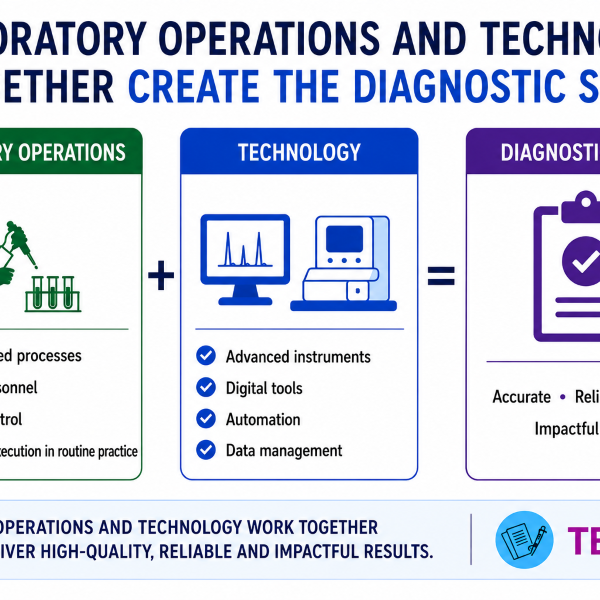
New technologies and laboratory operations should be viewed as interconnected components of the same diagnostic system. Together, they determine the quality, reliability, and impact of diagnostic results.
Understanding how technologies perform under real-world conditions may become just as important as understanding how they perform during development and validation.
TB-LOG
Making Laboratory Operations Scientifically Visible.