
One sentence appears repeatedly in scientific publications describing clinical studies and laboratory diagnostics:
«Microbiological tests were performed according to the study protocol.»
There is absolutely nothing wrong with this statement.
Study protocols are fundamental documents. They define how a study should be conducted, ensure consistency across participating sites, and support compliance with Good Clinical Practice and regulatory requirements.
In many clinical studies, the study protocol is not the only operational document. Laboratory procedures may also be described in a laboratory manual, often developed by the sponsor and distributed across participating laboratories to promote standardized laboratory practices.
This can help standardize what should be done.
However, this statement can be limited when viewed from a laboratory operational perspective.
Laboratory operations matter because they influence how procedures are executed and how consistently laboratory results are generated.
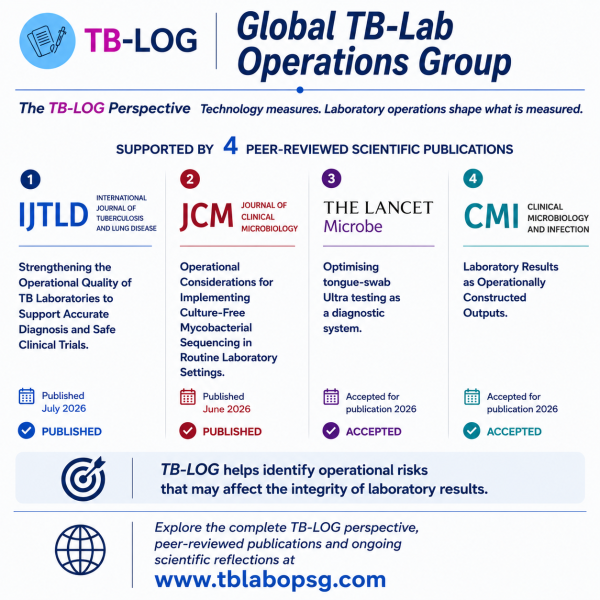
Technology measures. Laboratory operations shape what is measured.
This raises an important scientific question:
What does «according to protocol» actually tell the scientific community?
For scientists reading the publication, for laboratories planning to implement the methodology, or for researchers wishing to reproduce the work, the statement provides only limited operational context.
It does not necessarily describe how the laboratory responded to the operational demands of the study, what challenges were encountered during laboratory testing, or what operational lessons could support future clinical trials or research studies implementing the same or similar methodologies.
Importantly, this is not because study protocols or laboratory manuals are inadequate.
Rather, they are operational documents designed to guide study conduct and laboratory procedures, not to communicate laboratory operational execution to the broader scientific community.
Scientific publications serve a different purpose.
They exist to share knowledge, strengthen reproducibility, facilitate implementation, and allow others to interpret findings within an appropriate scientific context.
The objective is not to disclose confidential study protocols or laboratory manuals.
Rather, it is to provide sufficient operational information that helps readers better understand how laboratory results were generated in practice while fully respecting protocol confidentiality.
Operational insight does not require revealing confidential study documents.
It simply requires recognizing that laboratory execution itself contributes to the interpretation, reproducibility, implementation, and scientific value of laboratory findings.
One possible way forward is not to provide more narrative text, but to report key operational information in a structured and standardized manner.
A concise operational summary, supported by selected laboratory operational indicators, could provide valuable scientific context regarding how laboratory procedures were executed throughout the study without disclosing confidential protocol details.
Such an approach could strengthen scientific interpretation, improve reproducibility, facilitate implementation across different settings, and contribute to continuous laboratory improvement.
This perspective is consistent with the concepts presented in our recent publication in the International Journal of Tuberculosis and Lung Disease, which highlighted the importance of strengthening operational quality to support accurate tuberculosis diagnosis and safe clinical research. Rather than replacing existing reporting standards, operational summaries could complement current scientific publications by providing meaningful implementation context while fully respecting protocol confidentiality.
As diagnostic technologies continue to evolve, laboratory operations deserve increasing scientific attention—not because technology is insufficient, but because technology is ultimately implemented by people, processes, and laboratory systems operating under real-world conditions.
This perspective has gradually emerged through a series of four peer-reviewed publications exploring laboratory operational execution from different scientific angles.
Together, these publications suggest that laboratory operations should not be viewed solely as an internal quality activity, but also as a scientific component that deserves explicit consideration when interpreting, reproducing, and implementing laboratory results.
Protocols guide studies.
Scientific publications share knowledge.
Operational insight helps connect the two.
TB-LOG Perspective
Technology measures. Laboratory operations shape what is measured.
Related Publication
Strengthening Operational Quality to Support Accurate Tuberculosis Diagnosis and Safe Clinical Research
International Journal of Tuberculosis and Lung Disease (2026)
Available on the TB-LOG Publications page.