
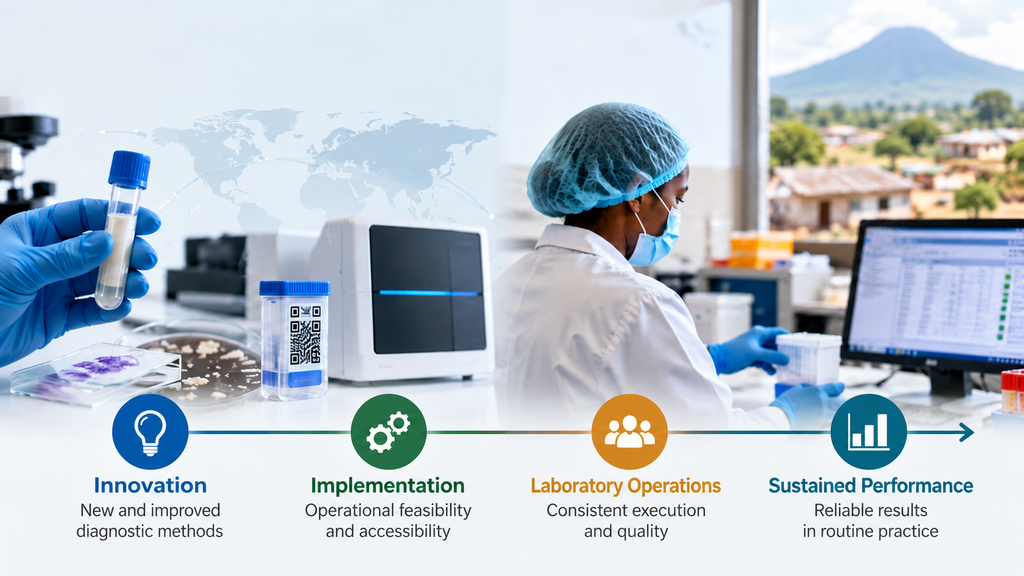
Tuberculosis diagnostic technologies have advanced considerably over recent decades. Rapid molecular tests, automated culture systems, and sequencing technologies have expanded diagnostic capabilities, improved turnaround times, and created new opportunities for detecting tuberculosis and drug resistance. These developments represent important scientific achievements and continue to strengthen tuberculosis diagnosis and patient care.
As diagnostic technologies evolve, however, an important consideration is how effectively these advances can be translated into routine laboratory practice, particularly in settings where tuberculosis remains highly prevalent and laboratory resources may be limited. In this context, accessibility means more than the availability of a diagnostic technology; it also involves the practical capacity of laboratories to implement, operate, and sustain it under their routine working conditions.
A new diagnostic method may demonstrate excellent analytical performance under controlled research conditions. Yet its successful implementation depends on several factors beyond analytical performance, including infrastructure, equipment availability, reagent supply, maintenance, operational costs, and personnel competencies. These factors can influence not only whether a technology can be introduced into a laboratory, but also whether its performance can be consistently maintained over time.
Innovation, therefore, does not necessarily require increasingly sophisticated equipment or complex laboratory procedures. Meaningful improvements may also emerge from simplifying existing methods, optimizing sample processing, developing affordable reagents, or reducing dependence on specialized infrastructure. Even relatively simple modifications to established procedures may offer important advantages if they improve diagnostic performance while remaining practical and affordable.
This perspective is particularly relevant to tuberculosis, where diagnostic solutions must respond to the realities of diverse laboratory environments. A method that performs well in a highly equipped research laboratory may encounter different challenges when implemented in facilities with limited infrastructure, restricted budgets, or high routine workloads. Recognizing these differences during research and development can help ensure that promising innovations are evaluated not only for their analytical performance but also for their practical applicability.
Laboratory professionals have an important role in this process. Their experience with specimen characteristics, processing conditions, workflow organization, equipment limitations, and routine quality control can contribute valuable information to the development and evaluation of diagnostic methods. Integrating this operational perspective into research may help identify opportunities for improvement that are scientifically meaningful and realistic for implementation.
Beyond implementation, another important consideration is whether diagnostic performance can be consistently maintained under routine laboratory conditions. The successful introduction of a technology does not necessarily demonstrate its sustained performance over time. Routine laboratory data, quality indicators, and periodic operational evaluations can provide valuable information on how diagnostic methods perform beyond their initial evaluation. This applies not only to newly introduced technologies but also to established laboratory procedures, where continued availability and use should be accompanied by evidence of consistent execution and performance.
The challenge is to continue developing better diagnostic technologies while also considering their operational feasibility, affordability, and long-term sustainability. This requires considering accessibility and implementation conditions throughout diagnostic development and evaluation, rather than treating them solely as concerns arising after a technology has been introduced.
Innovation should not only expand technological capabilities. It should also reduce barriers to access.
At TB-LOG, we consider operational feasibility, consistent laboratory execution, and sustained diagnostic performance essential elements in translating diagnostic innovation into reliable routine practice.