
In our recent peer-reviewed publications, TB-LOG has highlighted that tuberculosis diagnosis should not be viewed only in terms of diagnostic technology. It should be understood as a diagnostic system in which laboratory results are shaped by both the technology and the Operational Workflow surrounding its use, from specimen collection through processing, testing, interpretation, and result reporting.
Related peer-reviewed publications: IJTLD 2026 | CMI 2026 | JCM 2026 | The Lancet Microbe 2026
See the TB-LOG Publications section for full references and links
The technology may remain the same across laboratories. GeneXpert, for example, uses the same diagnostic platform and technical principles. What may differ is how specimens are collected, transported, received, handled, processed, tested, reviewed, and reported. These operational conditions may influence how a diagnostic technology performs in routine practice.
For this reason, understanding laboratory performance requires attention not only to what technology is being used, but also to how the laboratory workflow is being executed over time.
From this information alone, do you know how the Operational Workflow of your laboratory has been executed over time?
A common response may be:
“Our Operational Workflow is good/acceptable as we have SOPs, accreditation, quality systems, experienced personnel, appropriate equipment, and established safety procedures»
Although all of these are essential components of laboratory quality, they do not necessarily show how the laboratory workflow has actually been executed over time.
SOPs describe how procedures should be performed. Accreditation and certification assess defined requirements. EQA and other quality activities provide valuable information at specific points in time. But they do not always allow the laboratory to reconstruct its operational history or determine whether execution has remained consistent across different periods, workloads, operators, or laboratory conditions.
This raises another question:
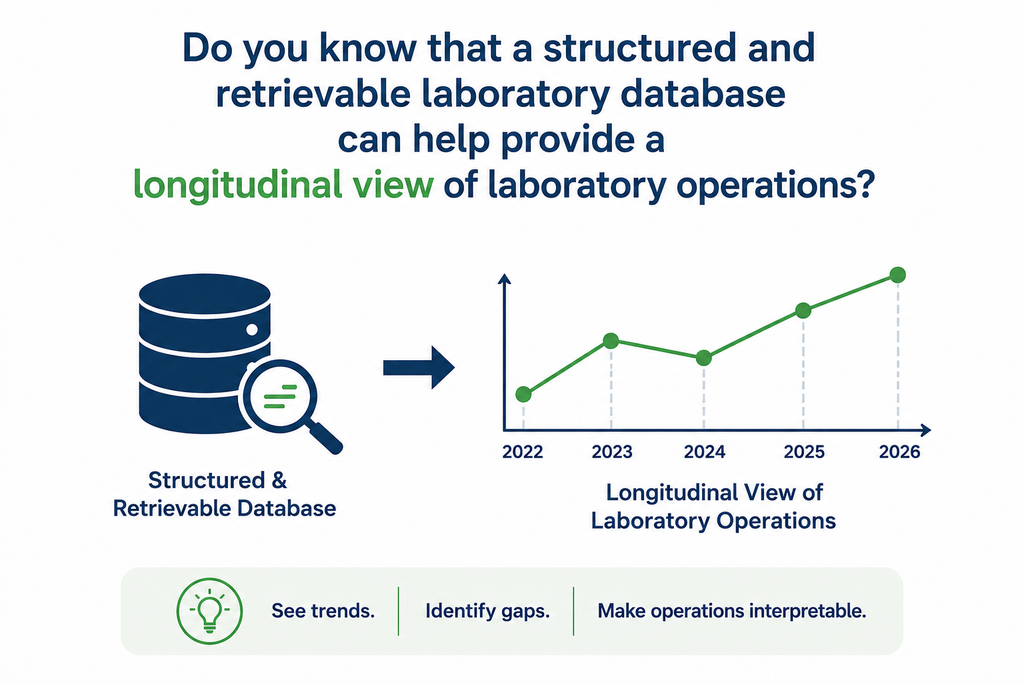
Do you know that a structured and retrievable laboratory database can help provide a longitudinal view of laboratory operations?
Laboratories routinely generate information during specimen receipt, processing, testing, interpretation, and reporting. When laboratory information is consistently recorded in physical source documents and transferred into a structured and retrievable electronic format, it can support reconstruction of key parts of the specimen-to-result pathway and longitudinal analysis of operational patterns.
Depending on the laboratory setting, a properly structured electronic database or spreadsheet may provide sufficient information. A sophisticated LIMS is not necessarily required. What matters is that relevant data are structured, retrievable, longitudinal, and suitable for analysis.
This capability complements existing quality systems. It does not replace SOPs, QC, EQA, accreditation, audits, or direct observation. Instead, it adds the possibility of understanding how Operational Execution has occurred over time.
Importantly, making laboratory operations visible means making Operational Execution interpretable through the laboratory’s own data.
This rationale underpins the TB-LOG Remote Operational Workflow Identification (ROWI) approach. ROWI uses structured, routinely available laboratory data to preliminarily reconstruct key parts of the operational workflow and identify operational patterns or signals that may require further assessment. Structured and retrievable routine data are therefore a prerequisite for ROWI.
For laboratories without structured routine data, the next question is:
Would you like to establish a structured dataset that allows you to understand and monitor your Operational Execution over time?
For laboratories that already maintain structured data, the next question is:
Are you using those data to understand your Operational Workflow, or are you mainly using them to store and report laboratory results?
A structured database is not the endpoint. It is the foundation for making laboratory operations traceable and interpretable over time.