
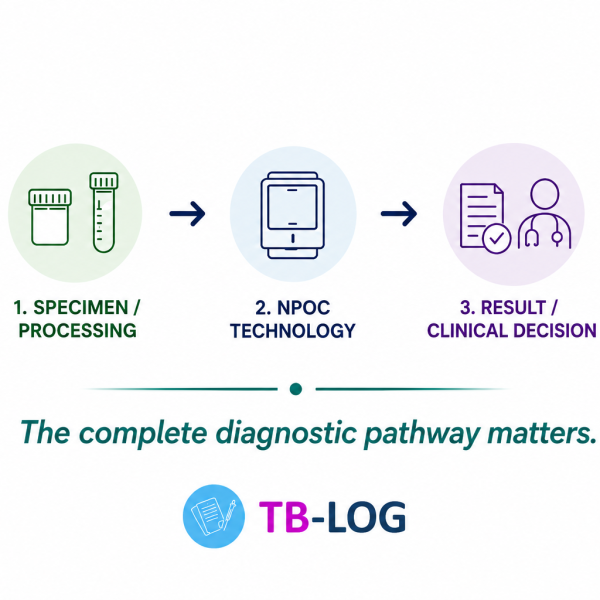
Point-of-care and near-point-of-care molecular technologies are changing the way diagnostic testing can be delivered. Smaller instruments, increasing automation, simplified procedures, and shorter time to results are bringing sophisticated diagnostic capabilities closer to patients.
This technological progress is important.
But there is a distinction that should not be overlooked:
Technological simplicity does not necessarily mean workflow simplicity.
At TB-LOG, this distinction is part of the diagnostic landscape we are working to make more visible.
A point-of-care or near-point-of-care instrument performs an essential analytical function, but it operates within a broader diagnostic pathway. There are activities before the instrument, activities inside the analytical process, and activities after the instrument produces a result.
The reliability and clinical value of the final result depend on how these activities work together.
What happens before the instrument?
Before a sample reaches a diagnostic platform, several operational activities may already have taken place.
The specimen must be appropriately obtained, identified, handled, transported when necessary, and prepared according to the requirements of the diagnostic method. Depending on the test, additional processing may also be required before the specimen enters the instrument.
These activities may appear straightforward, particularly when compared with the sophistication of molecular technology. But each represents part of the conditions under which the diagnostic result is generated.
A highly automated instrument cannot retrospectively correct every problem that occurred before the sample reached it.
This is why simplifying the analytical technology does not automatically simplify the pre-analytical pathway.
The instrument is one part of the diagnostic system
Point-of-care technologies are frequently discussed in terms of their analytical characteristics: sensitivity, specificity, time to result, portability, automation, connectivity, or infrastructure requirements.
All of these characteristics matter.
But performance in practice also depends on how the technology is integrated into routine operations.
Are procedures standardized?
Are operators appropriately trained?
Are responsibilities clearly defined?
Can the workflow be performed consistently under routine workload and staffing conditions?
Can deviations be identified when they occur?
These questions do not compete with technological performance. They help create the conditions in which technological performance can be translated into reliable diagnostic practice.
And what happens after the instrument?
The diagnostic pathway does not end when the instrument displays a result.
The result must be reviewed, recorded, communicated, and made available to the appropriate clinical team. Depending on the diagnostic context, it may then contribute to additional testing, treatment decisions, patient referral, or other clinical actions.
This means that time to result is not necessarily the same as time to clinical action.
A rapid molecular result has limited impact if reporting is delayed, communication pathways are unclear, or the result does not reach the people responsible for the next decision.
The post-analytical pathway therefore deserves the same operational attention as the steps occurring before testing.
From a simple technology to a reliable diagnostic pathway
The objective of point-of-care and near-point-of-care diagnostics is not simply to move an instrument closer to the patient.
It is to bring reliable diagnostic information closer to the clinical decision.
Achieving this requires visibility across the complete pathway:
Pre-analytical pathway → POC/NPOC technology → Result → Reporting → Clinical decision
The technology may become smaller.
The analytical procedure may become faster.
The number of instrument steps may decrease.
But the diagnostic pathway still needs to function as a system.
Making operational execution visible
At TB-LOG, our objective is to help make this operational component of diagnostics more visible and more systematically considered alongside technological development and evaluation.
We are contributing to this discussion through scientific publications, analysis of emerging diagnostic approaches, peer review, and the development of practical operational frameworks for laboratory and clinical research settings.
Our published work has explored how laboratory operations influence diagnostic reliability, how laboratory results are operationally constructed, and why technological performance and operational execution need to be considered together.
As diagnostic technologies continue moving closer to patients, we believe operational evidence should evolve alongside analytical and clinical evidence.
The question should therefore not only be:
Does the technology work?
but also:
Does the complete diagnostic pathway work?
Diagnosis is more than a device, a technology, or an analytical method.
It is a pathway that begins with the specimen and continues through testing, result generation and reporting, ultimately supporting clinical decision-making.
At TB-LOG, making that complete pathway—and the operational execution within it—more visible is part of how we aim to contribute to more reliable diagnostic practice.