
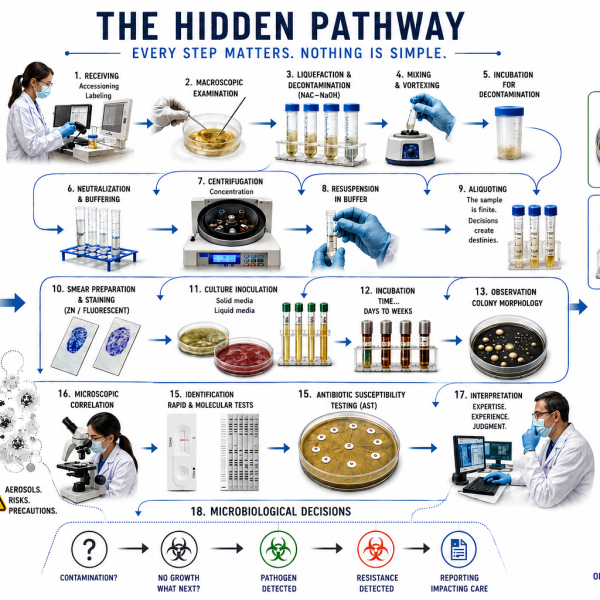
Exploring the operational side of TB diagnostics
Tuberculosis (TB) diagnostics has evolved substantially through the expansion of rapid molecular testing, automated liquid culture systems, sequencing technologies, point-of-care diagnostic platforms, and emerging specimen collection approaches such as oral swabs.
These advances have significantly improved detection speed, accessibility, and microbiological characterization.
However, an important scientific question still deserves greater attention:
What happens before the specimen reaches the instrument?
In routine laboratory practice, diagnostic reliability already begins long before molecular amplification, automated culture positivity, or downstream analytical interpretation occurs.
It begins with specimen collection.
Specimen collection, storage conditions, transport coordination and sputum process (homogenization, decontamination, resuspension methods, aliquoting procedures) directly influence what finally enters the diagnostic platform.
Many of these activities are still frequently considered routine laboratory procedures.
However, they directly influence specimen representativeness, bacillary recovery, contamination risk, viability assessment, microbiological interpretation, and ultimately diagnostic reliability.
The specimen is not always operationally identical.
Even when the same patient is evaluated, independently collected specimens obtained on different days frequently differ in sputum composition, bacillary distribution, viscosity, specimen representativeness, and recovery potential.
Similarly, specimen handling procedures themselves introduce additional operational variability.
Recent studies evaluating swab-based TB diagnostics have already highlighted how collection procedures — including sampling intensity, contact duration, number of swabs collected, and specimen handling — influence downstream diagnostic yield.
These observations suggest that analytical performance alone does not fully explain diagnostic variability observed between laboratories, studies, or operational settings.
Operational representativeness before analysis
In many TB workflows, sputum homogenization and aliquoting procedures are performed before downstream culture or molecular testing.
However, microbiological representativeness depends not only on whether homogenization is performed, but also on HOW it is operationally executed.
Different laboratories use vortexing, pipette aspiration and release, manual mixing, or magnetic stirring systems.
These methodological variations influence bacillary distribution within the specimen, particularly in paucibacillary samples.
Likewise, aliquoting strategies, sediment resuspension, and sequential dispensing procedures influence downstream specimen representativeness before inoculation or molecular testing begins.
Microbiological interpretation remains operational
Even after automated systems generate positive signals, microbiological interpretation frequently continues requiring operational and analytical integration.
Interpretation of positive liquid cultures may still depend on smear microscopy, colony morphology, blood agar findings, antigen testing, molecular identification, viability assessment, and epidemiological context.
These interpretative processes become particularly relevant during treatment monitoring, discordant molecular results, contamination assessment, evaluation of mixed populations, and interpretation of persistent molecular positivity.
Therefore, diagnostic interpretation does not always represent a fully automated analytical event, but rather a sequential microbiological resolution process.
Technology and operational execution
Modern diagnostic technologies have substantially strengthened TB diagnostics.
However, technological capability alone does not fully guarantee operational consistency under real laboratory conditions.
Workload pressure, staffing limitations, workflow organization, inconsistent follow-up procedures, and variability in microbiological supervision influence how standardized procedures are ultimately executed in practice.
Recognizing these operational dimensions is not intended to criticize laboratories or personnel.
Rather, it is intended to support greater scientific visibility regarding how diagnostic reliability is operationally constructed under routine laboratory conditions.
Moving forward
As TB diagnostics continue evolving, improving operational consistency becomes increasingly important for clinical diagnostics, implementation research, multicenter clinical trials, sequencing workflows, culture interpretation, and evaluation of emerging diagnostic technologies.
The objective is not to oppose technological innovation.
Rather, it is to recognize that diagnostic performance also depends on how specimens are operationally generated, processed, interpreted, and microbiologically resolved before and beyond the analytical platform itself.
Because one of the most important scientific questions in diagnostics should not be ignored:
What happens before the instrument?
TB-LOG continues making visible the operational and microbiological dimensions of TB diagnostics through ongoing scientific discussions and publications focused on laboratory execution, microbiological interpretation, operational consistency, and diagnostic reliability.
Selected References
1. World Health Organization. Global Tuberculosis Report 2025. Geneva: WHO; 2025.
2. Datta S, Shah L, Gilman RH, et al. Comparison of sputum collection methods for tuberculosis diagnosis: a systematic review and pairwise and network meta-analysis. Lancet Glob Health. 2017;5:e760-e771.
3. Namuganga AR, Chegou NN, Mubiri P, et al. Suitability of saliva for tuberculosis diagnosis: comparing with serum. BMC Infect Dis. 2017;17:600.
4. Church EC, Steingart KR, Cangelosi GA, et al. Oral swabs with a rapid molecular diagnostic test for pulmonary tuberculosis in adults and children: a systematic review. Lancet Glob Health. 2024;12:e45-e54.
5. Zhang F, Wang Y, Zhang X, et al. Diagnostic accuracy of oral swab for detection of pulmonary tuberculosis: a systematic review and meta-analysis. Front Med (Lausanne). 2024;11:1278716.
6. Rojas-Ponce G, et al. Detection of Mycobacterium smegmatis from urine suspensions using mycobacteriophage D29. J Microbiol Methods. 2022;197:106490.
7. Global Laboratory Initiative. Mycobacteriology Laboratory Manual. GLI/Stop TB Partnership; 2014.